Update your browser or Flash plugin
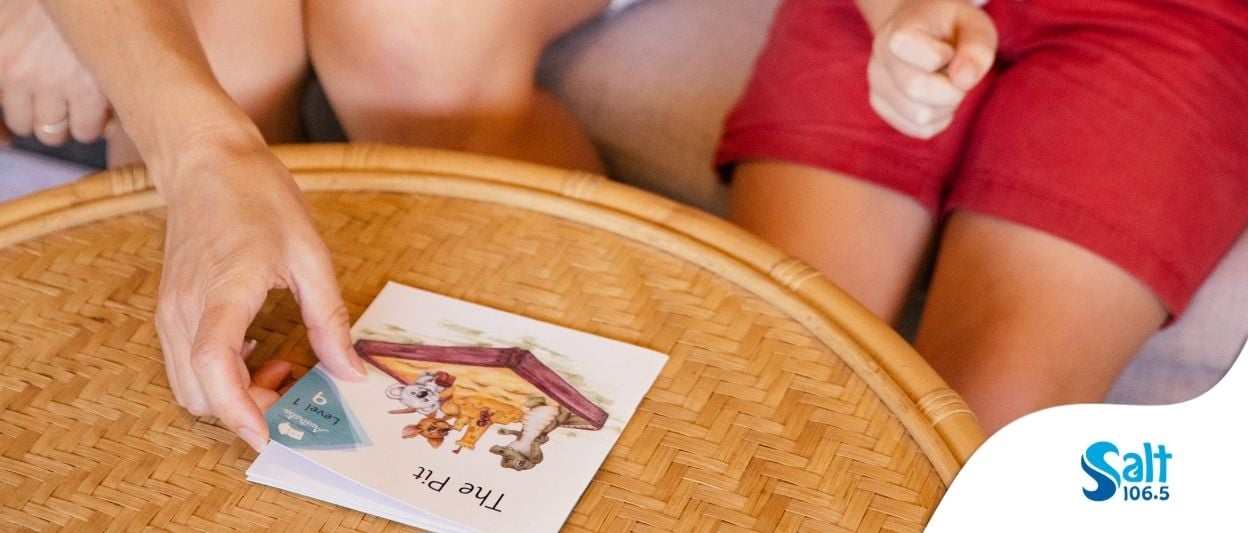
Listen: Kellyanne recommends decodable readers: books that are sequenced and organised according to phonemes (or sounds).
Choosing the right books for children learning to read can feel overwhelming with so many options available.
Key points:
- “Decodable readers or decodable texts are basically books that are sequenced and organised according to phonemes (or sounds).”
- “Phonemes is a speech sound, and graphemes are the letters that represent those sounds.”
- Most English words follow patterns: “Most words can be sounded out.”
- Listen to the full conversation in the player above.
However, a local Sunshine Coast teacher with 16 years of experience has a clear answer that could transform how parents approach early reading.
Kellyanne, a mum of an eight-year-old and founder of a tutoring business on the Sunshine Coast, recently shared her expertise on Salt 106.5 about the best books for beginner readers and how parents can support their children’s reading journey.
The secret is in decodable readers
When asked which books are best for beginner readers, Kellyanne had a specific recommendation that many parents might not be familiar with.
“If you go to any local library and ask for decodable readers or decodable texts, these are basically books that are sequenced and organised according to phonemes (or sounds),” she explained.
Kellyanne broke down why these books are so effective: “We teach children to read using a group of phonemes at a time.
“The reason these books are the best books for beginner readers is they don’t have all of the phonemes of the English language all at once… there are 44 phonemes in the English language.”
The staged approach makes learning manageable: “Beginner readers don’t need to know all of those off by heart at the beginning. You will teach maybe eight to begin with.
“Decodable readers or decodable texts are basically books that are sequenced and organised according to phonemes (or sounds).”
“Stage one of your decodable texts will just have the first eight sounds within those books, which makes it a lot easier for children to blend and read those eight sounds.”
Understanding phonemes and sounds
Kellyanne explained the difference between phonemes (sounds) and graphemes (letters), helping parents understand why the English language can be tricky for new readers.
“Phonemes is a speech sound, and graphemes are the letters that represent those sounds.
“For example, the letter A can say A. It can also say A. That’s where English gets tricky,” she said.
This systematic approach is what makes decodable texts so valuable: “The decodable text, they are organised in a way that introduces students to these phonemes in stages.
“Whereas if you just pick up any book from the library, that’s great. You can read that to your child because you most likely have a good knowledge of all the phonemes.
“But to learn to read, you cannot just pick any book off the shelf. You need these decodable texts.”
“Phonemes is a speech sound, and graphemes are the letters that represent those sounds.”
When to start and why it works
Kellyanne recommended starting decodable books “anywhere between four to six years old. Really depends on the child. Each child is unique.”
However, she emphasised preparation is important: “But before getting them into those books, listening to lots of rhyming songs, there are lots of songs that introduce the sounds that letters make.
“This is a great way just to get the ears ready.”
She also suggested adapting familiar games: “Playing games at home that get them ready for like a little bit of a twist on I Spy.
“You know how we say I spy with my little eye? Something beginning with mmm. We don’t use the letter name. We’ve got to steer away from using the letter name. It’s not really that helpful in learning to read.”
Most English words follow patterns: “Most words can be sounded out.”
What makes decodable books different?
The key advantage of decodable books is their predictability.
“Basically, decodable means you can sound out the word. In these decodable books, you’re not going to get those tricky words. You’re not going to get sight words.
“When I say sight words, I’m referring to words that have irregular spelling patterns,” Kellyanne explained.
She reassured parents that most English words follow patterns: “Most words can be sounded out.”
Top tip: make use of your local library!
Practical advice for parents
For parents ready to try decodable readers, Kellyanne offered simple guidance: “Just visit your local library and at the back of the book it will say which phonemes are included in that book.
“If you point to those phonemes, it’ll just be letters on the back of the book.
“Say to your child, what sound does this make? If they can identify the sound that those letters make, that book will be good for them.”
This approach helps parents choose appropriate books and assess their child’s readiness for each level.
Listen to the full conversation in the player above.
A game-changing approach
Kellyanne’s advice represents a shift from simply picking any picture book to using specially designed texts that support systematic learning.
By focusing on decodable readers and sound-based games, parents can give their children a structured path to reading success.
Her message is clear: the right books, introduced at the right time with the right preparation, can make all the difference in a child’s reading journey.
Listen to the full conversation in the player above.
Feature image: Photo supplied by The Reading Village and used with permission.
Feature image: Supplied (The Reading Village)
Get daily encouragement delivered straight to your inbox
Writers from our Real Hope community offer valuable wisdom and insights based on their own experiences!
Subscribe + stay connected with all
our latest stories
"*" indicates required fields